Stop producing more bullshit content, focus on quality.
Too often, we see brands ‘ordering’ videos of a maximum of 60 seconds ‘because it would be better’ and ‘because long videos aren't watched.’ While short videos are very important for grabbing attention, you need longer (video) content to truly convey your knowledge and expertise.
In the B2B world, buyers typically take 6 to 12 months to make a purchase. The choice of a B2B partner is often complex and has a significant impact. However, once a decision is made, parties often enter into a long-term collaboration. These collaborations rely on reliability and trust. Therefore, your task as a B2B marketer is to claim the position of a reliable partner in the minds of your target audience. And that's where long-form content will help you.
What is the difference between long-form content and short-form content?
As the name suggests, short-form (or snackable) content is short, concise media. Think of short videos between 12 seconds and 2 minutes, short text posts, or short audio messages. Long-form content offers depth. This includes longer texts (over 1,500 words) and videos longer than 10 minutes.
What is the purpose of short-form content and when should it be used?
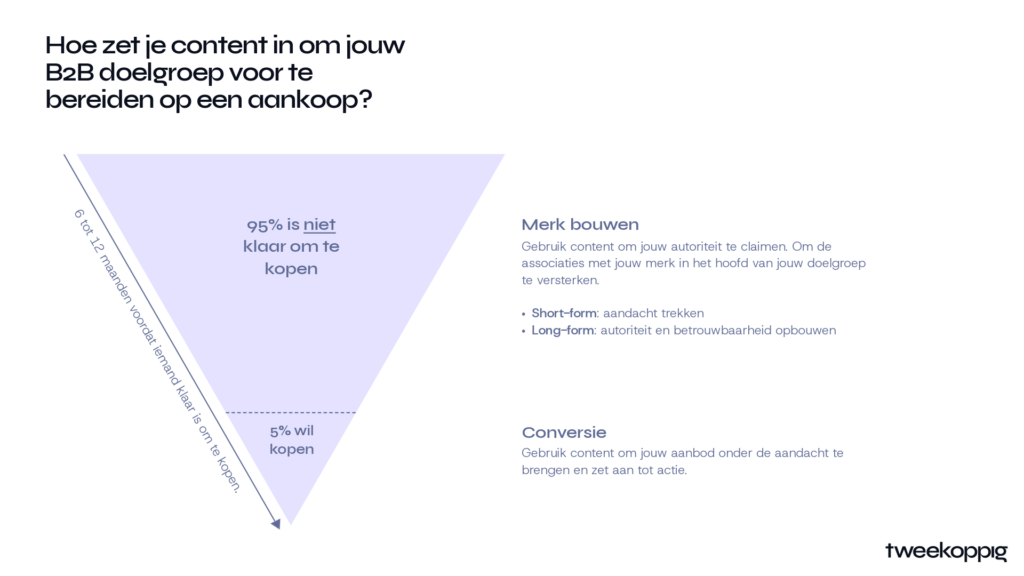
Short-form content is aimed at attracting attention. With these short media messages, brands tap into the need for that quick dopamine hit. It's about entertainment and quick recognition. The art in this form of content lies in quickly conveying your core message and provoking interaction. It's a great way to briefly engage and reach your target audience via their smartphone.
Examples of short-form content can be found on TikTok, Instagram Reels, YouTube Shorts, and short posts on X, LinkedIn, or Substack.
reach with short-form content Brand awareness and stay on your target audience's radar. Additionally, you can use short-form content to entice your target audience to delve further into your brand through long-form content.
What is the goal of long-form content and when do you use it?
With long-form content, you build your brand's authority. In longer videos and blogs, you can demonstrate that you are indeed an expert in your field. In these longer media messages, you share your knowledge to build trust with your (potential) target audience. This is essential to ultimately motivate potential buyers to become customers.
For long-form content, you can think of explainer videos, documentaries, full podcast episodes, and in-depth blogs and white papers.
Long-form content increases your reliability. By consistently sharing knowledge without expecting anything in return now, you demonstrate that you are an expert in your field. And you show that you understand that decisions in your world have a long lead time. Instead of pushing for the sale, you focus on sharing your knowledge and open the door to valuable interactions.
Why is long-form content a game-changer in the B2B world?
In the B2B world, only 5%% of your market is ‘ready to buy’ right now. That means 95%% are not yet, and might only make the decision in 6 to 12 months. Pushing your target audience to buy now doesn't work. And in the worst-case scenario, it can even backfire.
Omdat 95% van jouw doelgroep nog niet klaar is om de beslissing te nemen, is het belangrijk om de doelgroep klaar te maken om in de toekomst de beslissing wel te kunnen nemen. Daarbij wil je jouw merk in het geheugen van de doelgroep krijgen.
How? By providing your target audience with the right knowledge to make an informed decision. Long-form content is the ultimate way to share knowledge and establish yourself as an expert in your field. In longer videos, in-depth blogs, or podcasts, you have the time to explain things, show who you are, and thus build trust. This is something that simply cannot be achieved with short-form content.
5 reasons to start with long-form content immediately
Long-form content being a great way to convey your expertise is, of course, nothing new. There has always been a place for long-form content. But with the advent of AI, the importance of qualitative (!) long-form content has become even greater. In 2026, the importance of long-form content will therefore shift from nice-to-have to must-have. Below, you can read why.
The Importance of ‘Information Gain’ for SEO and AI
Google and LLMs like ChatGPT, Gemini, and Claude utilize the principle of ‘information gain.’ Information gain is the extra value a reader or algorithm receives from your specific content. In other words: how much new information do you add to the already available information online. The higher the information gain, the greater the chance that you will appear at the top of search engine results or be used as a source by AI.
Google has patented the principle of ‘information gain’ for its search engine. This means that new content, with high information gain, ranks higher. As a content creator, you are thus rewarded for adding new content. Or more precisely, ‘unique data points’. Even if your website has lower authority, your specific article can appear high in the search results. This is why websites that used to rank very well in SEO do not automatically maintain their position. You must share new data points, new insights, new research results to stay relevant.
Now that we know this, you also understand why long-form content is better for this than short-form content. In short-form content, it's difficult to add ‘something new.’ Long-form content offers the space for in-depth analysis and substantiating new perspectives.
E-E-A-T is still important for your trustworthiness and therefore findability
E-E-A-T stands for Experience, Expertise, Authoritativeness, and Trustworthiness. Google uses E-E-A-T to assess whether your content is relevant and therefore should rank high in search results. In addition to adding new data points, it is therefore important that your content addresses these four components:
- ExperienceDo you show with your content that you truly have experience with the subject you are writing/talking about yourself?
- ExpertiseDo you have proof of your experience in your field? Consider your organization's track record.
- AuthoritativenessIs your word/brand seen by others as an authority in your field?
- TrustworthinessAre you trustworthy? Do you exude professionalism, is it easy to trace who you are, what you base your information on, and whether you are a safe partner. Trustworthiness seems to be the most important thing for Google at the moment.
You can't score well in all these areas with short-form content alone. With podcasts, research reports, white papers, in-depth blogs, and videos, you can effectively demonstrate why you are the go-to party in your field.
A bit of a no-brainer, but a high E-E-A-T score can only be achieved by humans. Real people, sharing real experiences. People who have worked hard to reach a certain level of expertise. Even Google filters out AI bullshit content from its results.
3. Readers and viewers of long-form content are your target audience
For too long, I've seen marketers focus on a large number of views, likes, and comments. But these don't say anything about your target audience's willingness to actually become a customer. Views and likes, in particular, can be ‘easily’ increased with entertaining content. But entertaining content doesn't lead to a greater willingness to buy. Your true target audience, therefore, consists of people who look beyond entertainment. Those who are seeking expertise.
People who take the time to read and/or watch your long-form content. These are the people who are genuinely interested in your product or service. Who really want to know what you have to say because they are truly interested. These are also the people who will eventually become customers and spread your knowledge further. Note: these are often silent followers. Followers who watch your content for months but never send a message or like anything themselves. When they are ready to make contact, you'll probably hear something like ‘I've been following you for months and am so impressed with your working method.’.
So don't be discouraged if your long-form content doesn't achieve the measurable reach you'd like. After all, a smaller reach among a warm, relevant target audience is many times more interesting than a gigantic reach among people who are just looking for entertainment.
4. Anchor your brand in the minds of your target audience.
The longer someone interacts with your brand, the stronger the neural connection in the brain becomes. This increases the likelihood that someone will actually remember your brand and associate it with the correct associations. With long-form content, you increase the chances that people will spend more time on your channel and thus have more exposure to your way of thinking. This is essential for building a strong brand. Because while a brand is formed in the minds of your target audience, you as a brand can influence the associations people have with your brand.
Of course, visibility through short-form content also helps with this. Consistently repeating the same message makes it easier for your target audience to remember your brand. And ensures that you, as a brand, are top-of-mind when someone is ready to buy.
Long-form content adds an extra dimension here. Especially in the B2B world, it's important not only to be visible but also to show that you truly understand your industry. By sharing knowledge, you build this trust.
5. We are all desperately searching for ‘real’; long-form content offers the way out
In a world where AI dominates content production, and everyone can create a shitload of content with the press of a button, we are grimly searching for authenticity. Because who can you still trust when everyone suddenly claims to be an expert? AI videos are now difficult to distinguish from real videos, and LLMs are becoming increasingly better at humanizing their texts.
But there's one thing AI can't do: speak from experience and authenticity. AI videos and texts are often too polished and lack feeling. But you can sometimes see right through that if you really look. And who really looks anymore...?
In long-form content, you can take more time to share your experiences. To substantiate viewpoints with experience and knowledge. Longer videos featuring real people, real colleagues. Showing real footage of your field of work, engaging in conversations with other experts. That's where you make a difference. So, don't hesitate to make colleagues the face of your brand. Because that's where the experience lies, that's where the expertise lies, and those are the people your target audience will ultimately work with.
Don't forget: long-form content doesn't work without short-form content
It's clear that long-form content is very important for your content strategy in 2026. But don't forget; you won't get there with only long-form content. Because no matter how brilliant your reports are, how fantastic your podcasts are, or how interesting your blogs are, if no one can find them, you won't achieve anything.
‘To be seen’ This is where short-form content will help you. With short quotes from that long blog, short video snippets from that video podcast, or behind-the-scenes photos, you'll pique people's interest. This is the content that draws people to your channels. It motivates them to watch more of you. And once they know where to find your knowledge, you can draw them into your way of thinking.
See long-form content as the way to keep sharp on what your brand stands for
A short post is written quickly. A long blog post or a long video, however, requires a completely different approach. It requires you to know what you want to say. To do research so you can properly support your opinion. To choose your words carefully. Because you know that every word contributes to strengthening your brand. Your authority and reliability.
As an authentic and reliable brand, you cannot be guided by suggestions made by AI. Because you, as a brand, are the expert in your field. AI can at most inspire. Help to write a smooth-flowing text or brainstorm about the script. But your stance, your opinion, comes from you. Based on your experience and your vision.
If you understand this, you also understand that long-form content ‘it's not just there’. But that it is important to take the time for this. To clarify what you stand for. And time and again, to take a well-considered position.
Need help sharpening your (brand) story? Check out our discovery session.